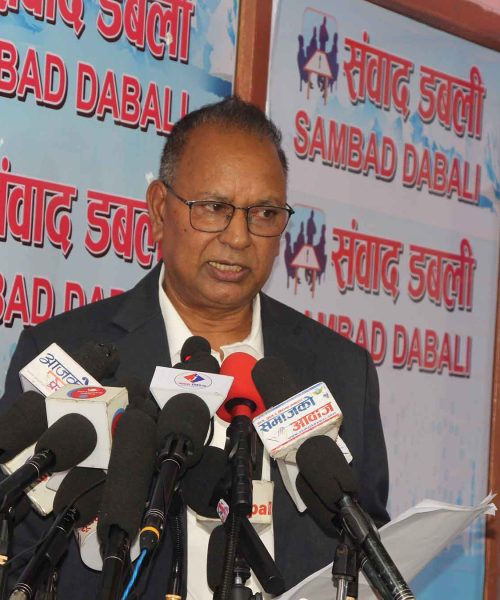
[Contribution of Revolutionary United Front of Nepal-RUFN to the Lenin Seminar: Lenin’s Teachings are Alive, Sept. 13-15, 2024.]
–Pari Thapa

Secretary of the United Front of Nepal(RUFN).
The Background:
Long before Lenin,the co-founders of Marxism, Karl Marx, and Fredrick Engels,formulated the basic worldview of Marxism in terms of the inter-relationship between the exploitation and hostilities of individuals, nations, and classes in this manner:
In proportion as the exploitation of one individual by another will also be put an end to, the exploitation of one nation by another will also be put an end to. In proportion, as the antagonism between classes within the nation vanishes, the hostility of one nation to another will come to an end.1 Here,Marx and Engels have pointed out that in a clear-cut way,the main crux of the matter is to end the exploitation and hostilities among them.They explained the question of oppression and liberation of the nations in a crystal-clear way in terms of the issues of Poland and Germany, the former as an oppressed nation and the latter as the oppressor nation, in this fashion:
A nation cannot become free and, at the same time, continue to oppress other nations. The liberation of Germany cannot, therefore, take place without the liberation of Poland from German oppression.2 Here,Marx and Engels have put forward the fundamental principle of Marxism that the issue of liberation of both the oppressor and oppressed nation sis reciprocal.
Lenin and the Significance of the National Liberation Movement:
Lenin was a great propounder and expounder of the national question and championed the question of the national liberation movement.Joseph Stalin wrote in a precise way in terms of Lenin’s contribution to the national question:
Leninism broadened the conception of self-determinism, interpreting it as the right of the oppressed peoples of the dependent countries and colonies to complete secession, as the right of nations to independent existence as states.3 The theory of national liberation developed by Lenin, as it were, gave rise to the independence of the former colonies to new sovereign nation-states.
Lenin clarified the meaning and significance of the right of nations to self-determination in an intelligible fashion in these terms, specifically concerning federation:The right of nations to self-determination implies exclusively the right to independence in the political sense, the right to free political separation from the oppressor nation. Specifically, this demand for political democracy implies complete freedom to agitate for secession and a referendum on secession by the assessing nation. This demand, therefore, is not the equivalent of a demand for separation, fragmentation, and the formation of small states. It implies only a consistent struggle against all national oppression.4
Types of Counties and the National Liberation:
Lenin divided the countries into three categories concerning the self-determination of nations:
First, the advanced capitalist countries of Western Europe and the United States. In these countries,progressive bourgeois nationals came to an end long ago. Every one of these “great” nations oppresses other nations both in the colonies and at home. Secondly, Eastern Europe: Austria, the Balkans, and particularly Russia. Here,it was the twentieth century that particularly developed the bourgeois-democratic national movements and intensified the national struggle. Thirdly, the semi-colonial countries, such as China, Persia, and Turkey, and all the colonies have a combined population of 1,000 million. In these countries, the bourgeois-democratic movements either have hardly begun or still have a long way to go.5 Lenin Summped up the situation as he saw in 1919 and distinguished three types of national movements:
The first type is the advanced countries of Western Europe (and America), where the national movement is a thing of the past. The second type is Eastern Europe, where it is a thing of the present. The third type is semi-colonies and colonies, where it is largely a thing of the future.6 Lenin further added, “To the old world, the world of national oppression, national bickering, and national isolation, the workers counter pose a new world, a world of the unity of the working people of all nations, a world in which there is no place for any privileges or the slightest degree of oppression of man by man.7 Lenin pointed out the important role of the national liberation movements against capitalism and imperialism and in favor of the world revolution:
It is apparent that in the impending decisive battles in the world revolution, the movement of the majority of the population of the globe, initially directed towards national liberation, will turn against capitalism and imperialism and will, perhaps, play a much more revolutionary part than we expect. It is important to emphasize the fact that, for the first time in our International, we have taken up the question of preparing for this struggle. Of course, there are many more difficulties in this enormous sphere than in any other, but at all events, the movement is advancing. And even though the masses of toilers—the peasants in the colonial countries—are still backward, they will play a very important revolutionary part in the coming phases of the world revolution.8
In addition to the rights of the nations to self-determination, he emphasized the need for regional autonomy and local self-governance under the democratic-republican system of governance:
Insofar as national peace is in any way possible in a capitalist society based on exploitation, profit-making, and strife, it is attainable only under a consistently and thoroughly democratic republican system of government that guarantees full equality of all nations and languages, which recognizes no compulsory official language, which provides the people with schools where instruction is given in all the native languages, and the constitution of which contains a fundamental law that prohibits any privileges whatsoever to any one nation and any encroachment whatsoever upon the rights of a national minority. This particularly calls for wide regional autonomy and fully democratic local self-government, with the boundaries of the self-governing and autonomous regions determined by the local inhabitants themselves based on their economic and social conditions, national make-up of the population, etc.9 Lenin maintained that, in confirming the right of all nations to secede and form a sovereign state, the Party of the Proletariat was not committed in all cases to advocating the application of that right. On the contrary, he recognized that in some instances, secession might be inappropriate:
The right of nations to self-determination (that is, the constitutional guarantee of an absolutely free and democratic method of deciding the question of secession) must under no circumstances be confused with the expediency of secession for a given nation. The social democratic party must decide the question exclusively on its merits in each case in conformity with the interests of the proletarian class struggle.10
The Proletariat and the National Movement:
Lenin not only formulated the theory and principles of the struggle for the national liberation movements but also developed the attitude of the proletariat toward this important issue:
In any case, the hired worker will be an object of exploitation. Successful struggle against exploitation requires that the proletariat be free of nationalism and be absolutely neutral, so to speak, in the fight for supremacy that is going on among the bourgeoisie of the various nations. If the proletariat of any one nation gives the slightest support to the privileges of its “own” national bourgeoisie, that will inevitably rouse distrust among the proletariat of another nation; it will weaken the international class solidarity of the workers and divide them, to the delight of the bourgeoisie. Repudiation of the right to self-determination or secession inevitably means, in practice, support for the privileges of the dominant nation. 11 Lenin made the attitude of the proletariat in terms of nationalism as follows:
The proletariat cannot support any consecration of nationalism; on the contrary, it supports everything that helps to obliterate national distinctions and remove national barriers; it supports everything that makes the ties between nationalities closer and closer or tends to merge nations. To act differently means siding with reactionary nationalist philistinism.12 Lenin sets a strict guideline for a proletariat in terms of the violence on the part of his nation against the nations in these words,quoting the assertion of Marx and Engels:
No nation can be free if it oppresses other nations (Marx and Engels). A proletariat that tolerates the slightest violence by its ‘own’ nation against other nations cannot be socialist.13
End Notes:
Marx Karl/Engels Fredrick, The Communist Manifesto, Chapter II Proletarian and Communist, Collected Works Volume 6 Page 501, Progress Publishers Moscow Second Printing 1984.
Marx Karl/Engels Fredrick, Speeches at the International Meeting held in London on November 29, 1847, to mark the 17th Anniversary of the Polish Uprising 1830,Collected Works Volume 6 Page 389, Progress Publishers Moscow Second Edition,1984.)
Stalin, J. V.,The National Question, Problems of Leninism Page 67, Foreign Language Press Peking, First Edition 1976.
Lenin, V. I., The Socialist Revolution and The Rights of Nations to Self Determination, The Significance of the Right to Self-Determination and Its Relation to Federation, Collected Works Volume 22 Page 146, Progress Publishers Moscow, Third Printing 1977.
Ibid,Page 50/51.
Lenin, V.I., A Caricature of Marxism and Imperialist Economism, “Our Understanding of the New Era” Collected Works Volume 23 Page 38, Progress Publishers Moscow Fourth Printing 1977.
Lenin, V.I., The Working Class, and the National Question, Collected Works Volume 19 Page 91, Progress Publishers Moscow, Fifth Printing 1980.
Lenin, V. I., Third Congress of the Communist International, Report on the Tactics of the R. C. P. July 5, Collected Works Volume 32 Page 482, Progress Publishers Moscow, Sixth Printing 1986.
Lenin, V. I., Resolutions of the Summer, 1913, Joint Conference of the Central Committee of the R.S.D.L.P. and Party Officials, Resolution on The National Question, Collected Works, Volume 19 Page 427, Progress Publishers Moscow, Fifth Printing 1980.
10.Ibid,Page 429.
Lenin, V. I., “Cultural-National Autonomy”, Collected Works Volume 20 Page 35, Progress Publishers, Third Printing 1977.
12.Ibid, Page 35/36.
13.. Lenin, V. I., Socialism and War, Chapter I The Principles of Socialism and the War of 1914–1915 Collected Works Volume 21 Page 317, Progress Publishers Moscow Third Printing 1977.
The End