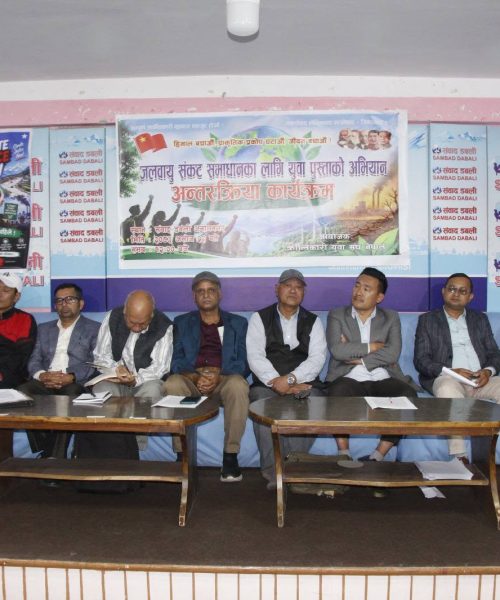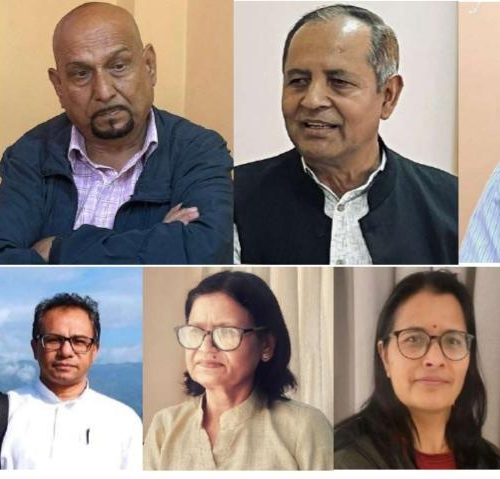
[Contribution of the Revolutionary Youth Association of Nepal (RYAN) by co-convener Dorchi Sherpa via video conference to the Youth Symposium held on 10 January 2026, Berlin, Germany, under the auspices of New Democratic Youth (YDG).]
Dear comrades and friends,
Revolutionary greetings from Nepal.
We express our sincere gratitude to the organising committee for the opportunity to attend and represent the Revolutionary Youth Association of Nepal (RYAN) at this International Youth Symposium. It is of particular significance for us to present and amplify the voices of Nepal’s revolutionary and struggling youth on this important international platform in Berlin, Germany.
On behalf of the Revolutionary Youth Association of Nepal (RYAN), we extend our heartfelt best wishes for the success of this International Youth Symposium and, in a spirit of solidarity, affirm our unity with the international youth movement and its struggles. We approve that uniting youth who are resisting exploitation and oppression by global imperialism and expansionism on a common platform—and building shared experience, perspective, and a joint course of action—is an indispensable necessity of our time.
Nepal’s Geographical Position and Youth Demographics
On the world map, Nepal lies between 26°22′ and 30°27′ north latitude and 80°04′ and 88°12′ east longitude. Nepal is a landlocked country situated between two large states: China to the north and India to the south. Its total area is approximately 147,516 square kilometres (56956 square miles). Of a total population of 29.65 million, 16,154,059 people fall within the 14 to 45 age group. The statute of the Revolutionary Youth Association of Nepal recognises this age group as youth. Youth, therefore, constitute 48.4 per cent of the total population. Of these, approximately 7 million have emigrated to third countries for employment and education.
The Contemporary Situation in Nepal and the Position of Youth
Nepal remains a neo-colonial country with semi-feudal and semi-colonial characteristics. Although political systems and terminologies have changed over time, no fundamental transformation has occurred in the livelihoods of the general population and of youth, as the essential organs of the state remain intact.
The same youth force that seized 80 per cent of the countryside during the 10-year-long People’s War—the young people who made history as the People’s Liberation Army—has now been driven to a point where they are prevented from even interpreting their own history. At the same time, the calculated manoeuvres of imperialism and expansionism have exploited and suppressed the sentiments of the brave and progressive youth who recently took part in the Generation Z (Gen Z) movement.
Despite the passage of time since the establishment of the parliamentary republic, the state apparatus continues to be dominated by imperialist interference, the comprador bourgeoisie, and old feudal structures. Unemployment, poverty, labour exploitation, and the deprivation of education and healthcare have produced among young people a psychology in which they are unable to imagine a future within their own country, and are increasingly drawn into individualistic thinking. As a consequence, millions of young people are currently selling their labour in Gulf countries and elsewhere, in conditions akin to modern-day slavery. Imperialist and expansionist powers, together with the comprador and puppet government, have played the primary role in creating and perpetuating this situation.
The Looming Crisis of Imperialism and Expansionism
Although Nepal is not a formal colony, it has become a victim of Indian expansionism and the broader imperialist system. Through past unequal treaties and agreements, the treacherous Millennium Challenge Corporation (MCC) agreement, the State Partnership Program (SPP), Gurkha recruitment, and the activities of NGOs and INGOs that intervene directly in people’s livelihoods, these forces have exerted ideological influence and economic pressure to keep the populace—and especially youth—under their control.
By intensifying security and political pressure, the current government has prepared the ground for producing a so-called “Nepali Zelenskyy” through the hijacking of the Gen Z movement, thereby undermining national sovereignty. This political climate has generated deep despair in the consciousness of youth and has been accompanied by pervasive feelings of anxiety and fear. The education system has been reshaped to serve the needs of the imperialist market. This has not only failed to make young people self-reliant within their own country, but it has also facilitated their transformation into cheap labour for foreign markets. The growth of such an individualistic mindset has distanced young people from organised struggle.
Youth Resistance and Struggle in Nepal
In Nepal, youth have consistently been at the forefront of struggle and resistance. At various stages of our history, Nepali youth have played decisive roles in struggles against feudalism, absolutism, and imperialism. In people’s wars, popular movements, and mass uprisings, the participation of youth has always been central.
The recent Generation Z (Gen Z) revolt also witnessed active participation by young people. Patriotic, progressive, and revolutionary youth are currently engaged in struggles across various fronts. Under the common slogans of free education, free healthcare, and dignified employment within the homeland, the Revolutionary Youth Association of Nepal (RYAN) is building organised structures to conduct programmes rooted in mass struggle, people’s resistance, and, ultimately, armed insurrection.
Domestically, we are waging struggles against corruption and misgovernance, and raising demands related to education, health, communication, and employment. We advocate for concrete programmes aimed at building a self-reliant national economy and transforming the production system in a scientific and creative direction.
Externally, the annulment of treacherous agreements such as the MCC, the SPP, and earlier unequal treaties remains a principal challenge. To confront this, it is essential to wage a vigorous and sustained struggle against imperialism and expansionism.
Regional Experience and International Tasks
Today, the experiences of youth struggles in various countries—including Palestine, the Philippines, Bangladesh, and Tunisia—demonstrate a clear truth: the root cause of the exploitation and oppression they face lies in the imperialist system. The lessons and experiences of Nepal also confirm this. Youth in every country must prepare themselves by organising with a clear political consciousness. Only through international solidarity and cooperation can genuine liberation and transformative change be achieved.
The situation currently confronting the people of Ukraine can be understood as a warning of the type of challenge that the people of Nepal may face in the near future as a result of imperialist activities. As imperialist activity is increasingly concentrated in South Asia, young people must organise and struggle against it on both regional and international levels.
Conclusion
In conclusion, we consider it imperative that this International Youth Symposium should not remain merely a forum for the exchange of ideas, but should serve as a foundation for developing a shared perspective and a concrete joint course of action. The Revolutionary Youth Association of Nepal (RYAN) declares its full commitment to working in close collaboration with youth organisations internationally to advance the anti-imperialist and pro-people revolutionary struggle. We extend this call to revolutionary youth throughout the world.
Thank you for your kind attention.
Our slogans
All oppressed and exploited youth of the world, unite!
Let us struggle against world imperialism!
Down with imperialism and expansionism!
Long live international youth unity!
Long live the international youth movement!